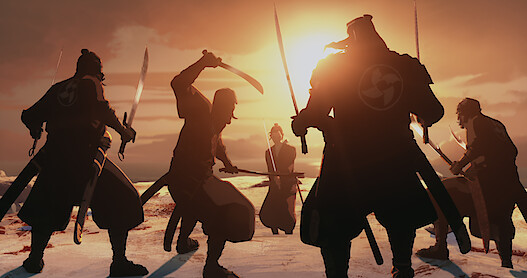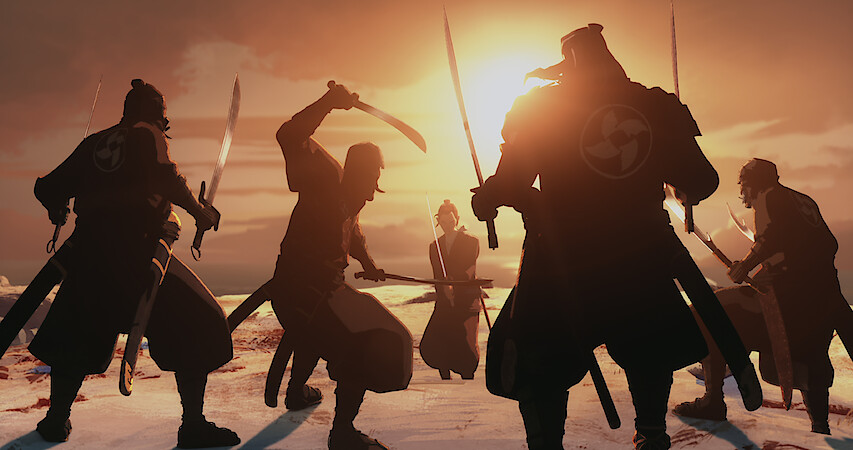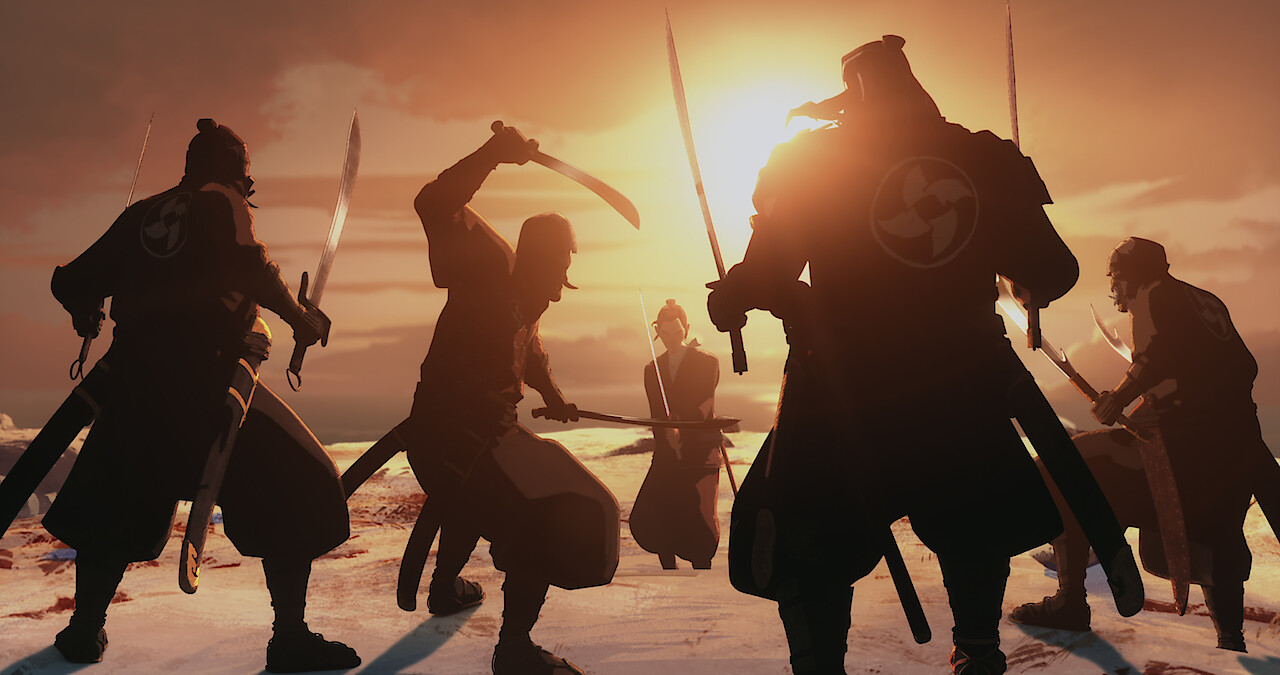
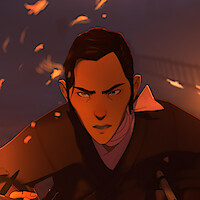


“It’s an Edo-period tale of revenge — ‘Kill Bill’ meets ‘Yentl.’”
“We really let the historicity drive story rather than trying to impose modern outlooks.”
What was it like to be a woman in Edo-period Japan? What would it have been like to be a woman who was considered a monster? What would somebody like that do? How would somebody like that respond?
These were all the questions simmering in the minds of Blue Eye Samurai’s creators, Amber Noizumi and Michael Green, when they began diving into the research for their Edo-period tale of revenge. “We really let the historicity drive story rather than trying to impose modern outlooks,” said Green.
Noizumi and Green’s research began by diving into as many books as they could absorb about the Edo period, both fiction and scholarship of the era (editor’s note: see their full list of references below). They focused as much as possible on the lives of women in the Edo period, especially around the idea of their limited options. “At that time, you could be either a wife, a daughter, or a prostitute,” said Noizumi. “In building the character of Mizu, we wanted to create this idea of a woman who is not going to be any of those things. A woman who forges her own path.”
Their mixed-race samurai Mizu (voiced by Maya Erskine) certainly does, as she disguises herself as a man to seek vengeance. So does her foil, Princess Akemi (Brenda Song), who has no desire to be either the property of her father or a husband.
Once Noizumi and Green started writing, they hired experts to bolster the research they’d already found for themselves. “With something like this, you only trust your own scholarship as far as you can go,” said Green. “We wanted to make sure we could hear from experts who’ve spent their lives inside of this period, who could keep us from taking the wrong kind of liberties.” Those experts included Harvard art history professor Yukio Lippit, professor and food consultant Eric Rath, and calligrapher Aoi Yamaguchi, as well as research-loving department heads like costume designer Suttirat Larlarb and production designer Toby Wilson.
Below, allow Blue Eye Samurai’s experts to take you on a tour of Edo-period Japan.
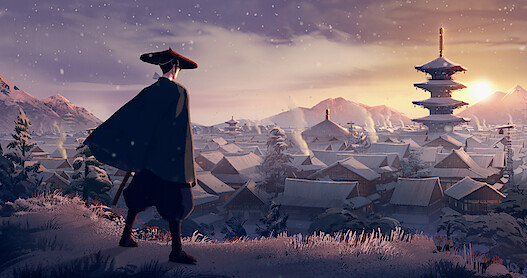
Blue Eye Samurai takes place in the 1600s, when Edo, Japan, “was the biggest city in the world,” per Green, “and it was very well-documented.” So Wilson and his team were always checking their work against 17th-century history. He and supervising director and producer Jane Wu made sure their artists presented their research along with their sketches before starting on assignments. Wilson had a particular connection to Japanese culture, as his wife is Japanese and his brother-in-law is a Japanese history buff who sent him books to learn about Edo Castle, the headquarters for Edo’s shogun (hereditary military leader). He could also help answer questions such as: How was it constructed? What was the layout? Where were things within the place? How were the defenses handled?
To create the writing style suitable for Edo-period official documents, signage, letters, and the paper wrapped around the Swordmaker’s (Cary-Hiroyuki Tagawa) steel, the team hired Japanese calligrapher Aoi Yamaguchi, whose dedication to her craft and training under calligraphy masters mirrors Mizu’s own apprenticeship under the Swordmaker.
You might think of the style of calligraphy a character uses as you would the style of your own handwriting, with everything handwritten usually using a brush and Sumi ink. “The difference between a female hand and a male hand that writes [the calligraphy] is very specific,” said Wu. For samurai Taigen’s (Darren Barnet) contract with Mizu in Episode 3, Yamaguchi used the visual reference of Tokugawa Ieyasu, who was one of the most influential shoguns for the period. “I also wanted that text to look really determined, [as] this writer is talking about where to meet for a duel, and it’s a life-and-death situation,” she said. Conversely, a letter penned by Akemi to her father would “look more elegant and more flowy in style, maybe with more curves throughout.”
Referencing her own calligraphy dictionary and Japanese history books, Yamaguchi would translate English words from the Blue Eye Samurai team into modern, formal Japanese, and then translate those words into old, formal Japanese, which was suitable for the Edo period. Today, Japan uses three types of characters: kanji, hiragana, and katakana, and in the Edo period, a variant of hiragana was used called hentaigana. “I researched this entire list of hentaigana to translate each symbol, one by one,” she said.
Ringo is a character born without hands, and Noizumi and Green explained that during the Edo period, a disabled character like Ringo might have been treated very differently than he is in the series. “We certainly have modern sensitivities that we were glad to employ, but we wanted to make sure that dignity was given to characters, even when those characters might not have been extended dignity at the time,” Green said.
Noizumi and Green wanted to be able to appreciate his outsider status, but never wanted to show levels of cruelty that he might’ve actually experienced to a point where it would be unpleasant to see. Noizumi explained that they wanted to ensure the audience always knew the series was laughing with Ringo and never at him. “We always wanted everyone to know he was on a path of rising above every limitation imposed on him. To us he is the heart of the show,” she said.
Brothels were a part of everyday life in the Edo period, and employment there was one of the limited career options for women. “One of the reasons we wanted an episode like Episode 4 was to humanize that part of their world, to meet the people who work there, to spend time with them without judgment, and get to know them as fully formed characters,” said Green.
As in the series, Japan’s borders were closed as of 1633 and were without Western Judeo-Christian influence, so “there wasn’t the same idea about sexual purity and shame,” Noizumi said. Even the Ukiyo-e block prints of the period were very graphic and explicit. In fact, they were common art back then, so, if in reality they weren’t ashamed of sexual acts, Noizumi thought, “We don’t need to be ashamed of it on our show. We can show it just the way it was.”
In reality, there’s no way Mizu could traverse the distances she travels in actual time, so Wilson advises viewers to chart this path with a grain of salt. For starters, Edo is today’s Tokyo, and Kyoto is still Kyoto. The port village in Episode 4 is based on Nagasaki, as it was one of the bigger port cities of that time.
Mizu’s husband Mikio’s (Byron Mann) ranch estate in Episode 5 is based on a historical village called Shirakawa-gō that is protected by the country of Japan. “People live there, and you can visit there and stay there in Airbnbs,” said Wilson. “It’s nestled in a valley surrounded by mountains, and it looks amazing in autumn.”
There isn’t an exact location for Mihonoseki, where Mizu’s cliff fight takes place, but it was based on the northwestern coast of Honshu. That’s also not far from Kohama Village, where Mizu and Taigen grew up. “It’s kind of in that area, or north of Nagano, because we needed to make sure that it would snow there; it had these really steep cliffs, and Mihonoseki isn’t too far from Kohama,” said Wilson.
Irishman Abijah Fowler’s (Kenneth Branagh) castle on Tanabe Island is based on the Aomori area, because the northern part of Honshu gets a lot of snow in the wintertime. They put him about as far north on the big island of Japan as they possibly could because “we wanted to keep him on Honshu so he didn’t have to get on a boat to travel down to Edo for his annual pilgrimage,” Wilson said.
Edo Castle was inspired by Himeji Castle, the largest castle in Japan. Wilson didn’t get to visit until after the project, as they worked on the series during the pandemic, but he went this past summer. “I told my family, ‘I have to go see Himeji.’ I wanted to see it and make sure that all of the research that I did was accurate,” said Wilson. It was.
Fowler’s isolated castle is entirely fictional and centered around the idea that the shogun built it for him as a “five-star, golden handcuffs–type prison,” said Wilson. Japanese masons and artisans built it for him with the idea of “what they thought a Westerner would want,” with more stone than a typical Japanese castle would have and arched windows with panes and pane glass. His European-looking dungeon “doesn’t look like a Japanese dungeon,” and, as Fowler points out, they built him a chapel. His castle is the one place you’ll find European cutlery, goblets, and candelabras.
Costume designer Suttirat Larlarb basically “lives in a library,” with monographs and books about costume and fashion history, and photography lining her apartment — and that’s a major reason why Green and Noizumi wanted to hire her for the job. “We worked together before [on American Gods], and he knew this is how my brain works, how I do my research, and how I like to inform character,” said Larlarb.
She’s so knowledgeable that she gave weekly costume lectures during production to teach the Blue Eye team more about the culture of the time, how a specific character might wear something to distinguish themselves, and how that distinction is related to something they do every day. “I have something like 30 PowerPoints, [with] 100 hours of work put into [each] one of them.” Larlarb said.
One thing to know as a baseline? “Saying ‘kimono’ is like saying ‘clothes.’” And Larlarb added that men and women’s clothing was essentially the same structurally in the early Edo period — the difference is in how they wear them, from length to surface decoration to color to fabric.
The Edo period was a time before mass consumption of clothing, when sumptuary laws ruled and kept class order in line. They controlled “the availability of certain things to certain classes of people,” explained Larlarb. “It’s one way to distinguish the classes from each other and prevent people from being too big for their britches and making the upper classes feel more special, and the lower classes feel aspirational towards the upper class.”
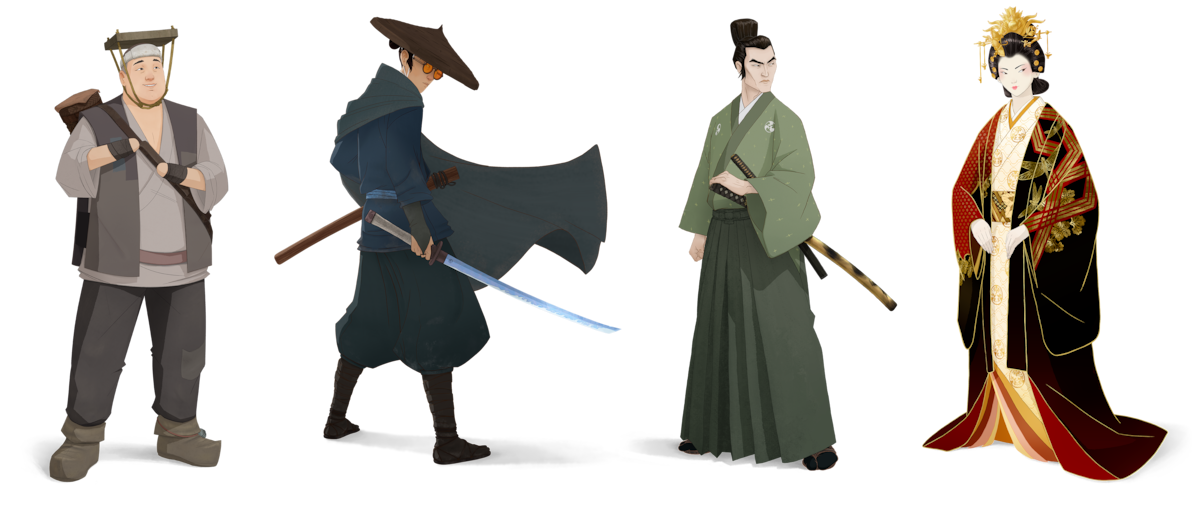
In Blue Eye Samurai, Larlarb wanted viewers to discern a character’s class instantly, from the shogun to a peasant. That’s part of the beauty of the series’ animation, calling back to the imagery of the Edo period, like in a sprawling epic where “you can really understand the story that a particular artist is trying to tell solely based on how people are dressed,” said Larlarb. For example, Mizu and Ringo have clothes made of recycled, rougher fabrics that come from their environment and would be darned bits of cloth, while Akemi, a princess, would be wearing fine, painstakingly dyed and embroidered silks.
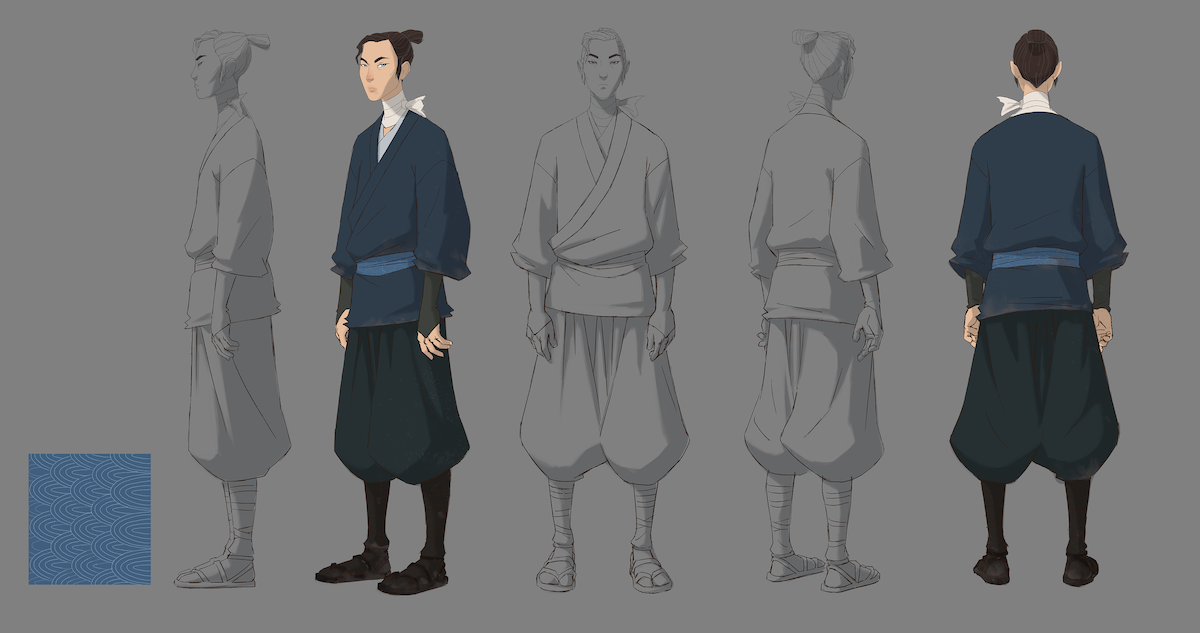
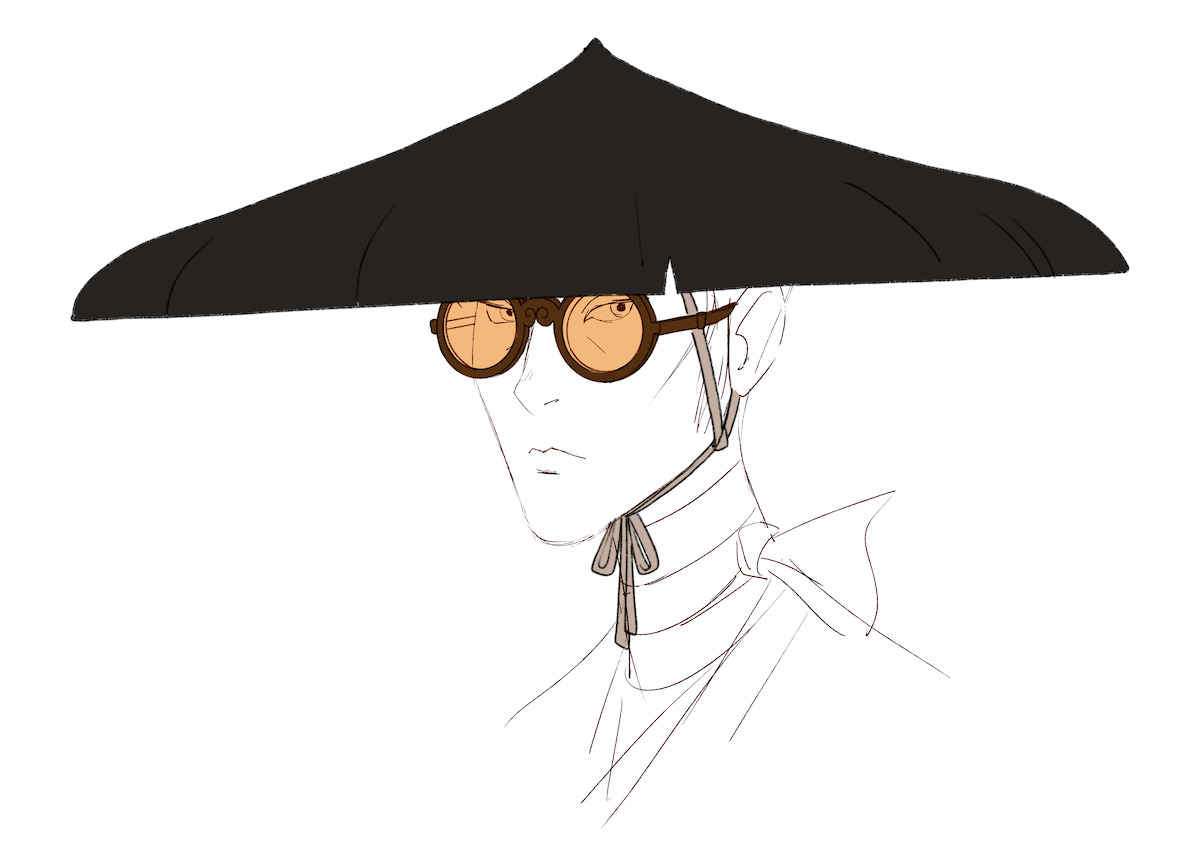
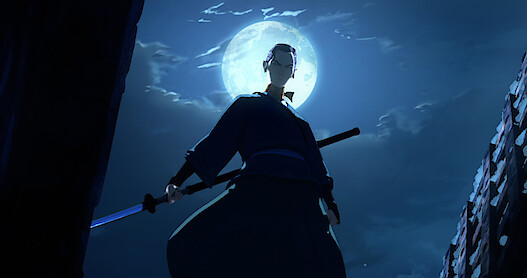
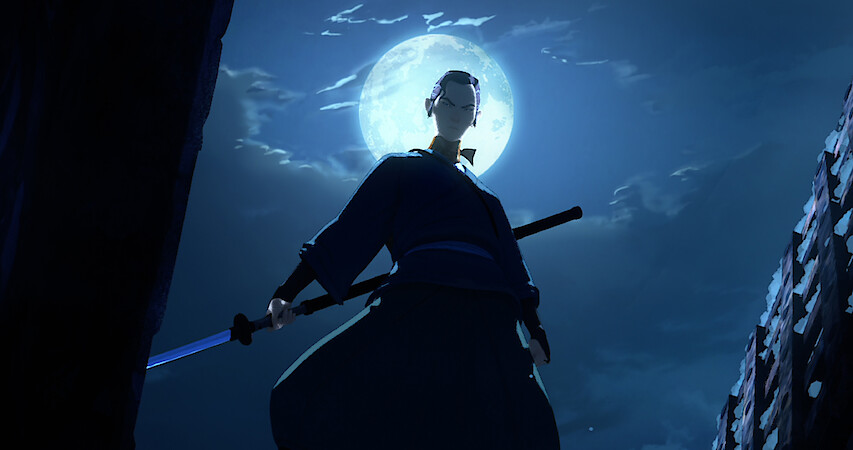
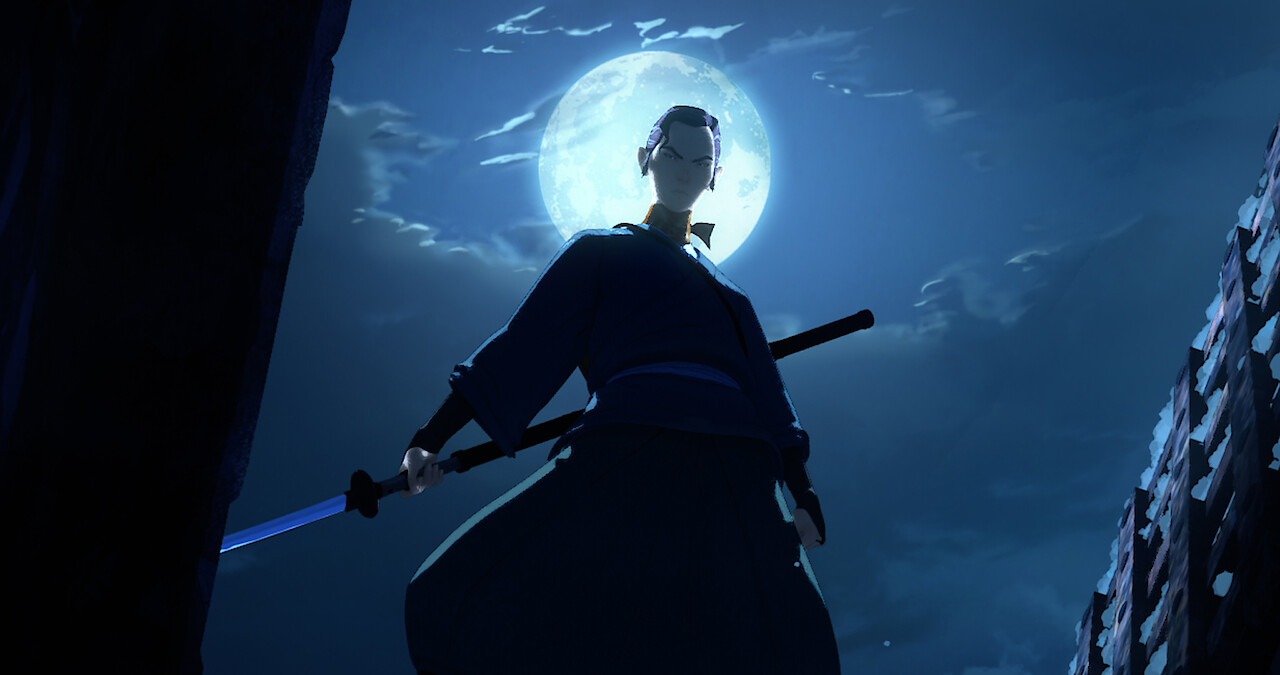
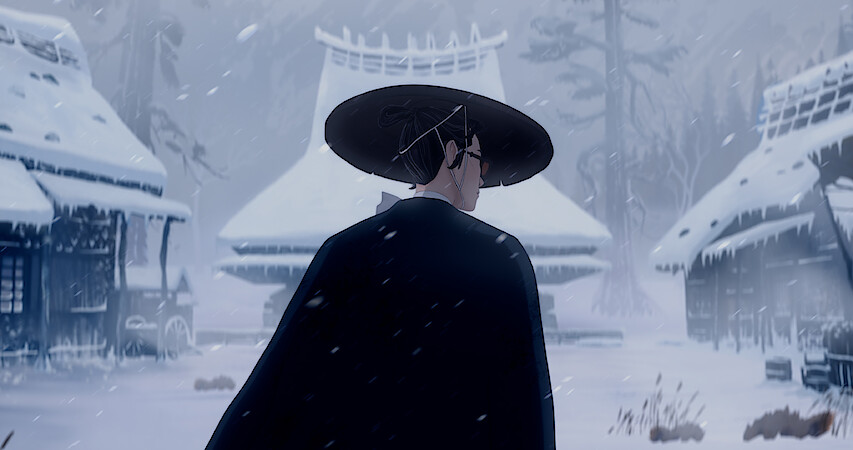
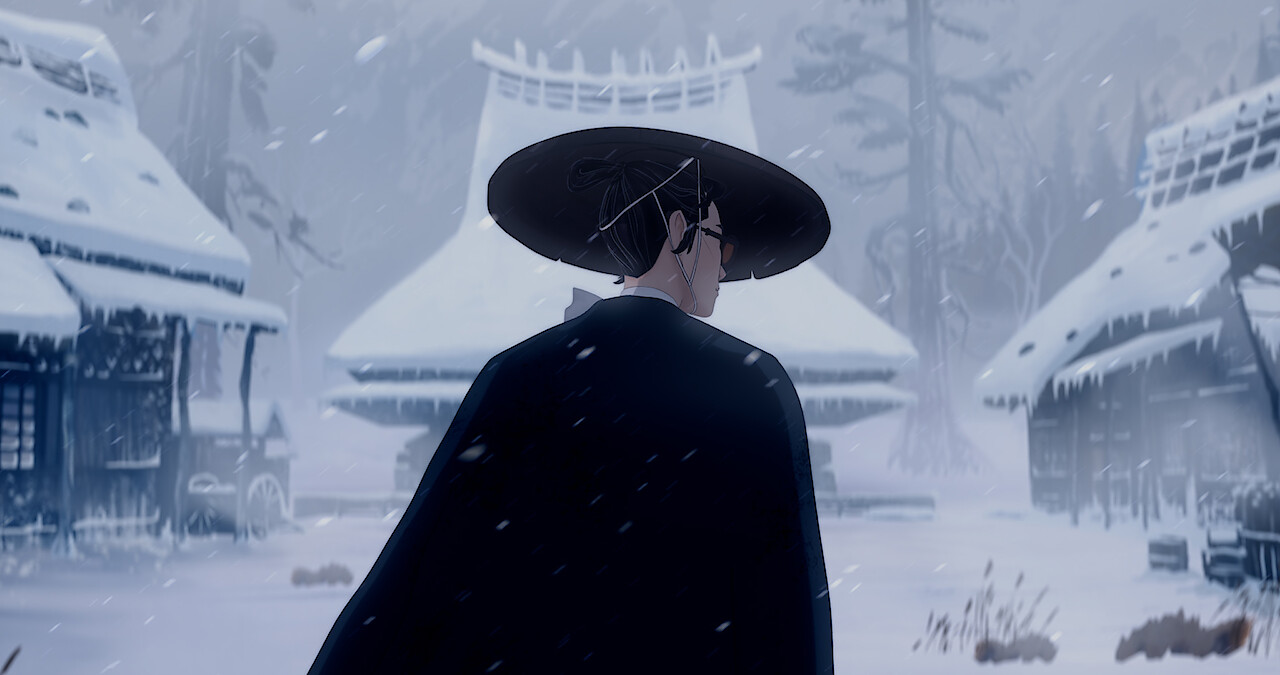
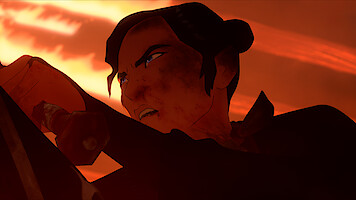
Mizu’s look was Larlarb’s favorite to design. “She needed to feel like a hero,” was the remit she received from Noizumi, Green, and Wu. As Mizu travels all the time, especially in the snow, Larlarb saw her costume as “her house” — essentially, a wearable shelter. Mizu’s kasa, or hat was covered all over with graphics from the period. (Kasa means “umbrella” in Japanese.) And it was a shape the team had in mind anyway, as there’s a cowboy-western element to the series, especially in Mizu’s saunter and behavior. “Just imagine this is Clint Eastwood in every single shot. That’s who Mizu needs to be,” Wu would say.
Because of Mizu’s history of metalsmithing with the Swordmaker, Larlarb’s idea for Mizu’s amber-tinted sunglasses was that Mizu would have forged them herself out of metal.
Mizu’s tenugui, or neck scarf, assisted in masculinizing her silhouette, as it is rather dapper and hides where a man’s Adam’s apple would be. Mizu’s leg wraps also distinguish her masculine silhouette, because“you’d never see the form of a woman’s leg in her kimono the way you would on a man,” said Larlarb. The wraps also telegraph just how mobile and active she is in the series. that she’d need to have her legs separated often.
Her cape is a flair, but actually comes from a historical garment that Portuguese missionaries wore as their uniform when they arrived very soon before the time of Blue Eye Samurai. Worn by the missionary elite first, the cape soon descended over time to commoners and became known as a traveling garment — perfect for a nomad like Mizu.
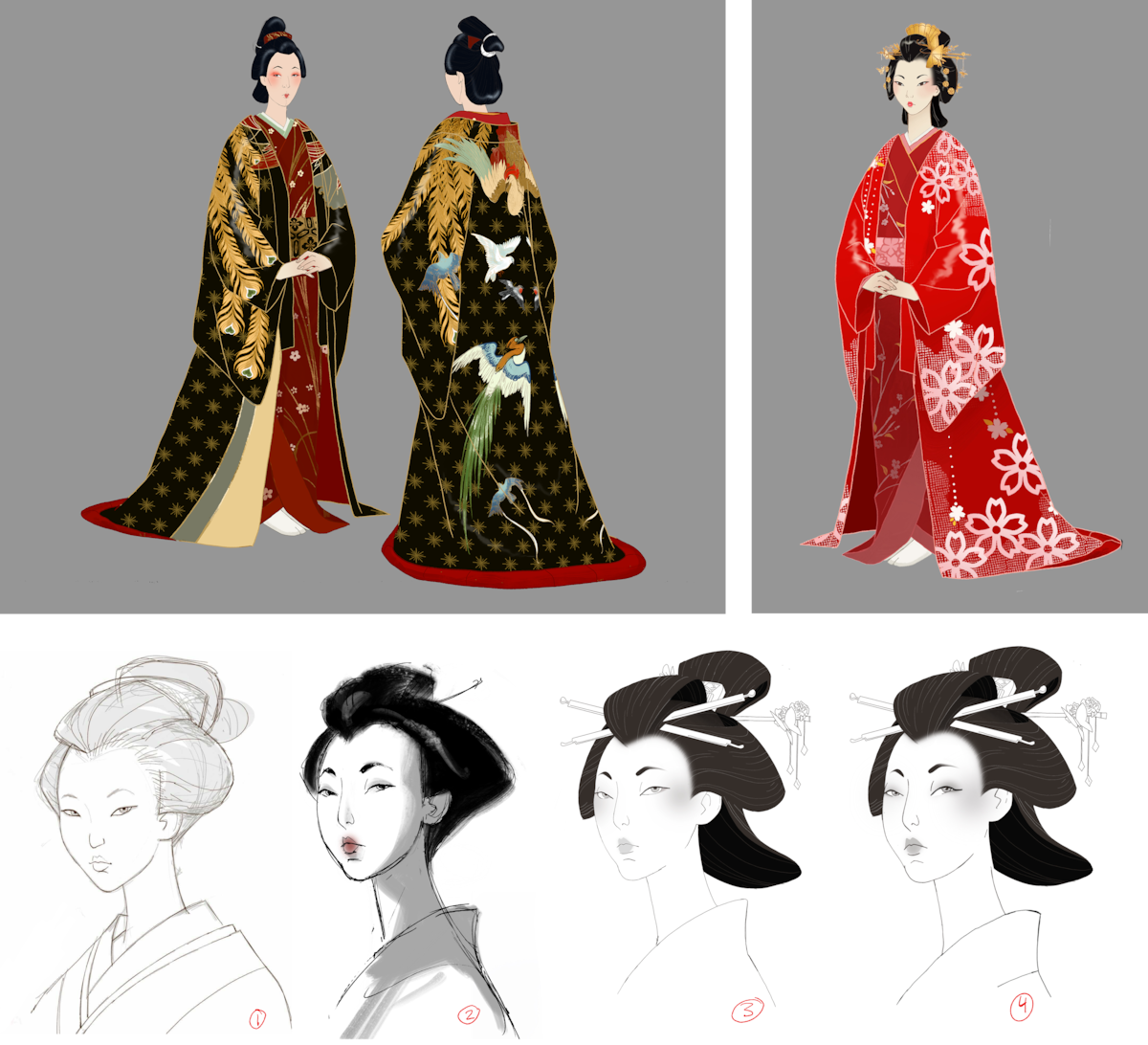
Larlarb saw Akemi as the Marie Antoinette of her day, driving fashion forward with avant-garde looks as a symbol of her status. Larlarb wanted Akemi to “feel a little bit out of time” — and, as she’s in a gilded cage, she has a lot of access and time on her hands to think about her appearance. Emerging in a traditional red color, her dramatic air is evident, even with the sprinkle of a gold constellation in her hair. As her exposure to the outside world grows in the series, her costumes evolve and hit a crescendo when she’s presented for marriage. “It’s the one that her father would’ve sanctioned to say, ‘Yeah, go spend all my money on that,’” Larlarb said.
Much of the imagery Larlarb found of the most fashionable women of the time was of prostitutes, like the women we meet in Madame Kaji’s (Ming-Na Wen) Nightjar brothel in Episode 4 of Blue Eye Samurai. Larlarb adorned their kimonos with flowers, fauna, birds, and color motifs that were meaningful for this period in Japan. She even provided a glossary of all the symbolism for her team’s references, like how the peacock on Madame Kaji’s kimono means “kindness, goodness, love, and care.” Madame Kaji was an opportunity to push Edo fashion even more than with Akemi, to demonstrate the flash and warmth of this empowered woman who spreads her wings to protect her flock of girls.
The Blue Eye team wanted to “make sure people left the show starving for Japanese food,” said Green. “We want there to be a soba bump, like the shawarma bump after The Avengers.” Wilson cited Hayao Miyazaki’s work as an inspiration, as “anytime Miyazaki puts food in his films, it’s amazing.” And, at the time in the Edo period, fast food was just starting to pick up. “We were dying to write about noodles,” said Green. “That’s why we have endless bowls of lovingly made noodles in there.” The buckwheat soba noodles Ringo makes and eats are available today, too, which was easy for Wilson’s team to research.
Wilson recalled that food consultant Eric Rath gave presentations to the team about what every member of the class system would eat in a day, from royals and nobles to samurais to peasants, which proved helpful for learning proper table etiquette at banquets and where items like the rice and soup would go. “We weren’t serving tempura because the Portuguese brought that, and they didn’t have it yet at that point in time,” said Wilson. So they mostly ate vegetables and fish.
Wilson’s team also had to learn where royals put the hashi (chopsticks) and what direction they’re facing, as that’s culturally very important. “They make a big deal of European etiquette for nobles in movies. So it’s like, ‘Make sure that you pay homage to Japanese etiquette.’ ” Even the tea and saké served at Madame Kaji’s brothel come from different kettles, like the one Akemi serves her noble client, Watari (Clyde Kusatsu), who eats an assortment of red snapper, salmon, pumpkin, pickled daikon, lotus, tofu, and miso soup. “All the food we designed for the show, we put in that room just to help illustrate the fact that this guy likes to eat,” said Wilson.
Remember Mizu’s sweet idyll with her husband, and how they would ride together to a fruit tree? That fruit was peaches. The script called for the colors of the peaches to change each time Mikio slices into one in Episode 5 “so we could show the passage of time from spring to summer to fall,” Wilson said.
The desserts that Heiji Shindo (Randall Park) serves at his tea ceremony with Mizu and Taigen are tied to the winter season. They are mochi cakes with red bean paste on the inside flavored with sugar, and some of them have chestnuts in them tied to the snowfall. “In the fall, you could gather [chestnuts], and then you could enjoy them in the late fall and into the winter.”
A READING GUIDE TO BLUE EYE SAMURAI
FILM INFLUENCES
Stream Blue Eye Samurai now, only on Netflix.