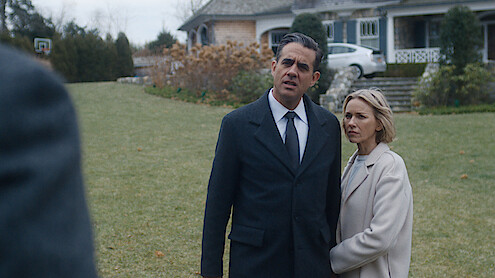


ALLYSON RIGGS/NETFLIX
Deep Dive
Inside the Dark Ending of Night Always Comes
Star Vanessa Kirby and director Benjamin Caron on the final act of their new drama.
Aug. 15, 2025
Lynette (Vanessa Kirby) is having a bad night. The protagonist of Night Always Comes has a matter of hours to raise $25,000 to buy her home — or else she and her family will be out on the street. Contending with her incalcitrant mother (Jennifer Jason Leigh) who would rather splurge on a new car, Lynette is forced to turn elsewhere: going through a Rolodex of odd jobs and past partners in order to make it through the night in one piece.
“It felt like one of thousands of stories out there,” Kirby tells Tudum of the film, based on the novel of the same name by Willy Vlautin. “I’ve met a lot of people who have been in really desperate situations like Lynette. I so admired her ferocity and her dedication to trying to find a better life, and often that’s a really hard journey to go on.”
For Lynette, that journey will lead her and her brother Kenny (Zack Gottsagen) through the streets of Portland, Oregon, after dark, and into an underworld that Lynette hoped she’d left behind. Through it all, the pair take care of each other — but will that be enough? “It always felt to me like at the heart of this story was this sibling relationship,” Emmy and Oscar nominee Kirby (Pieces of a Woman) says. “Both of them had their own separate struggles and both were very intertwined with each other.”
Read on to dive behind the scenes the ending of Night Always Comes, now streaming on Netflix.

Despite working two jobs and escorting on the side, Lynette finds herself running on empty when her mother, Doreen, pulls the rug out from under her. “I think the idea that you can work three jobs and not be able to afford your home is a uniquely modern tragedy,” Night Always Comes director Benjamin Caron tells Tudum. “Lynette’s story represents millions who are one paycheck or rent hike away from collapse. It’s a story of America’s working class —the nurses, the caregivers, the single moms — being systematically priced out of the very cities they keep running.”
After months of work, Lynette is forced to start fresh. She has less than 24 hours to make up the difference left behind by her mom, so she starts making her way down a list of increasingly desperate options. “The film is very much about how one bad decision leads to another and another and another,” Kirby says. “She makes some bad choices, but not because she’s intending to. In fact, she’s actually intending to only do something good. I think we can all relate to those choices you make in certain sudden impulsive moments in life, and hers happen to be intensely packed into one night.”
First bad decision: regular escort client Scott (Randall Park). Lynette asks him to lend her at least enough to cover the deposit on their home, but Scott laughs her off, telling her that he comes to her to have fun, not to hear about her family life. Lynette gives up, and accepts Scott’s payment for a trip upstairs to his hotel room — but afterward, in an impulsive moment, she also steals and abandons his car.
Second bad decision: Lynette’s sex worker friend Gloria (Julia Fox). “Julia Fox has such a vital energy onscreen,” Caron says. “She brought real humor and grit and sass to the role of Gloria, making her friendship with Lynette feel completely authentic.” If you keep a close eye out, you’ll spot an example of just how intense their friendship has been: Makeup designer Gemma Hoff gave Kirby and Fox matching tattoos.
But even with all that history Gloria doesn’t prove particularly helpful. She opens her politician boyfriend’s safe, pays Lynette a paltry $500 of the $3,000 she owes her, and hits the road almost immediately, leaving Lynette stewing in another apartment she can’t afford.

Lynette quickly turns to a new scheme: trying to crack the safe and make off with the money. After a few half-hearted attempts to guess the code, she recruits one of her bar co-workers, ex-convict Cody (Stephan James) to help out. At first she tells him it’s her safe and she’s simply forgotten the code, but Cody sees through her lie. He agrees to take the safe to a friend who will open it for them, for a price.
The price, like so many others in Lynette’s life, turns out to be too high. Cody’s friend cracks the safe and finds $19,000 in cash — and a brick of cocaine. The safe crackers try to steal the contents of the safe, and Cody and Lynette hit the road fast. Still $4,000 short, Lynette pleads with Cody to help her sell Scott’s stolen Mercedes.
First she has to pick up Kenny from a friend’s. Kenny and Cody get along famously, and it seems like everything is finally moving in the right direction. But when they reach the Mercedes, Cody lashes out at Lynette. She hasn’t paid him; she hasn’t given a single moment’s thought to how risky this entire endeavor is for an ex-con; and no, of course he isn’t buying the Mercedes. Cody grabs the money, and in another desperate moment Lynette runs him down with her car, leaving him injured in the road as she and Kenny tear off.
For Kirby, Cody’s section is the heart of the film. “[Stephan brought] such sensitivity to Cody, someone that could have been defined by one hard action towards Lynette — but instead he brought his own history and story without ever having to articulate it,” she says.
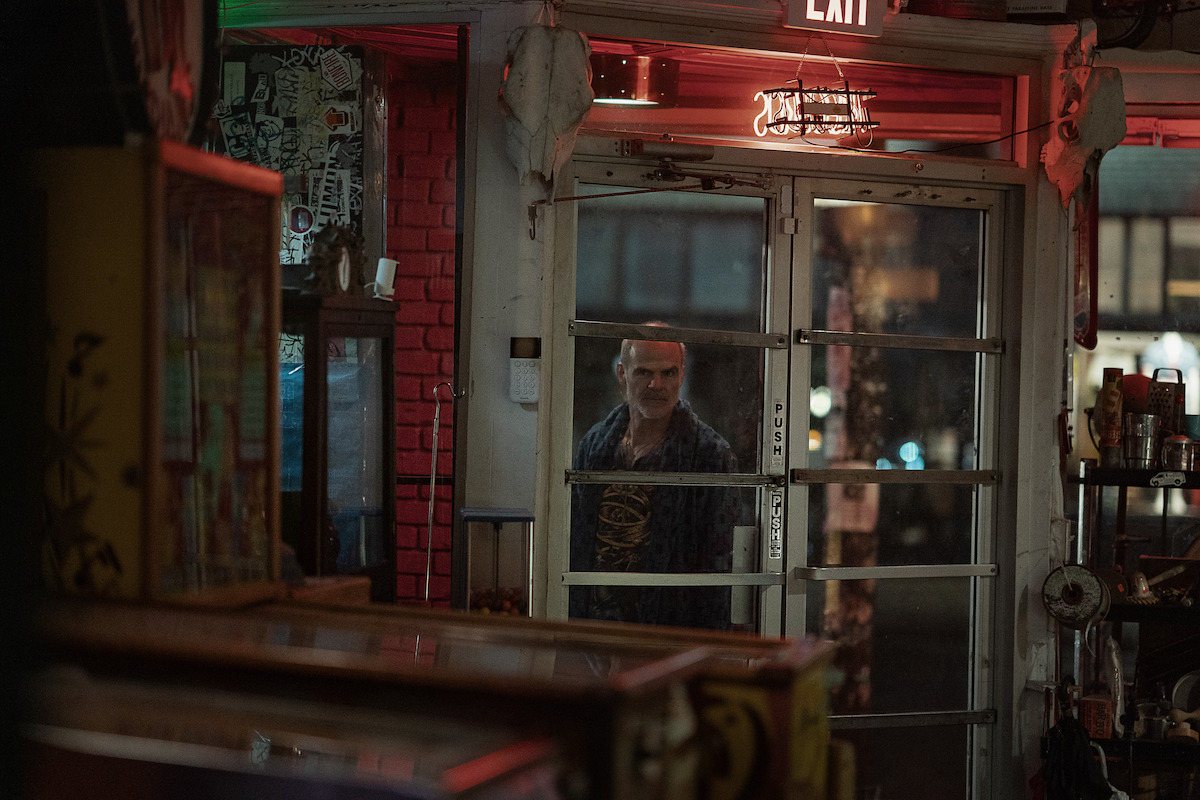
Finally Lynette turns to her last resort: Tommy (Michael Kelly), the former boyfriend who pushed her into sex work when she was just 16 years old. “Michael is one of the nicest men on Earth, and he was playing someone pretty dark,” Kirby says of her old friend Kelly. Tommy agrees to facilitate a deal for the cocaine from the safe — for $3,000, not 4. It’s not enough, but Lynette will take it.
The trip to Tommy’s buyer Blake (Eli Roth) isn’t a pleasant one, bringing up memories of Lynette’s teenage years being hauled around to dates by Tommy. “The final act finds Lynette confronting her deepest fears, staged within this labyrinth of a wealthy house,” Caron says. “Here, Lynette faces the forces that have shaped her story: class, money, gender, and the legacy of trauma.”
Blake seems equally aware of Lynette’s past. He refers to their sale as a “trip down memory lane,” and before she knows what’s happening, he pops in an airpod and tries to sexually assault her.
“Eli came in at the very end of our shoot because we shot it chronologically,” Kirby says. “He had to play someone really, really hard and unlikable, and he gave it everything. He didn’t hold back. He needed to be like that to truly make the scene fly.”
Once again, Lynette has to make an escape. She smashes Blake over the head with a lamp, finds Kenny, and hits the road, leaving the trappings of her past behind her.

Lynette’s final obstacle is the same as her first obstacle: her mother, Doreen. “The relationship between mother and daughter reflects a lifetime of love and damage,” Caron says. “Each scene was a battle.”
As Doreen picks shards of glass out of Lynette’s back (souvenirs from her escape from Blake’s home), Doreen tells her daughter the truth. In buying the car, she wasn’t acting out; she was actively trying to sabotage the purchase of their home. “This isn’t some magical place, honey,” she tells her. “It’s just all we could afford.”
After everything she’s been through during her long, dark night of the soul, Lynette finds herself right back where she started. Her mother chews her out for what she perceives as selfishness and self-righteousness. Lynette responds with the truth: She was just trying to look out for her family. Realizing at last that her mother doesn’t want her around, Lynette makes a clean break. She says goodbye to Kenny, leaves cash on the table for her mother and Gloria, and heads for the horizon, finally putting herself first.
“In the end, Lynette’s greatest moral act is to finally choose herself, to break the cycle of self-destruction that has defined her life,” Caron says. “I think for the first time, she steps into the unknown with a sense of agency. She’s learned that salvation is not found in a house or a relationship, but in the radical act of caring for herself.”
Night Always Comes is now streaming on Netflix.